
WiscNet eduroam
eduroam (education roaming) is a secure, worldwide roaming access service developed for the research and education community. Participating K-20 faculty, teachers, students, and staff enjoy uninterrupted Wi-Fi across all educational sites in their region and around the globe.

What is eduroam?
Right now, millions of students, teachers, researchers, and staff from libraries, schools, and museums are using Wi-Fi that automatically connects them to the internet in more than 10,000 locations across the globe. Dual-enrolled students going back and forth between campuses; teachers working in multiple buildings; researchers or faculty spending the day at the library; even foreign exchange students arriving at the dorms for the first time — so many of them are staying connected to the internet wherever they go and without having to enter credentials every time they move to a new location.
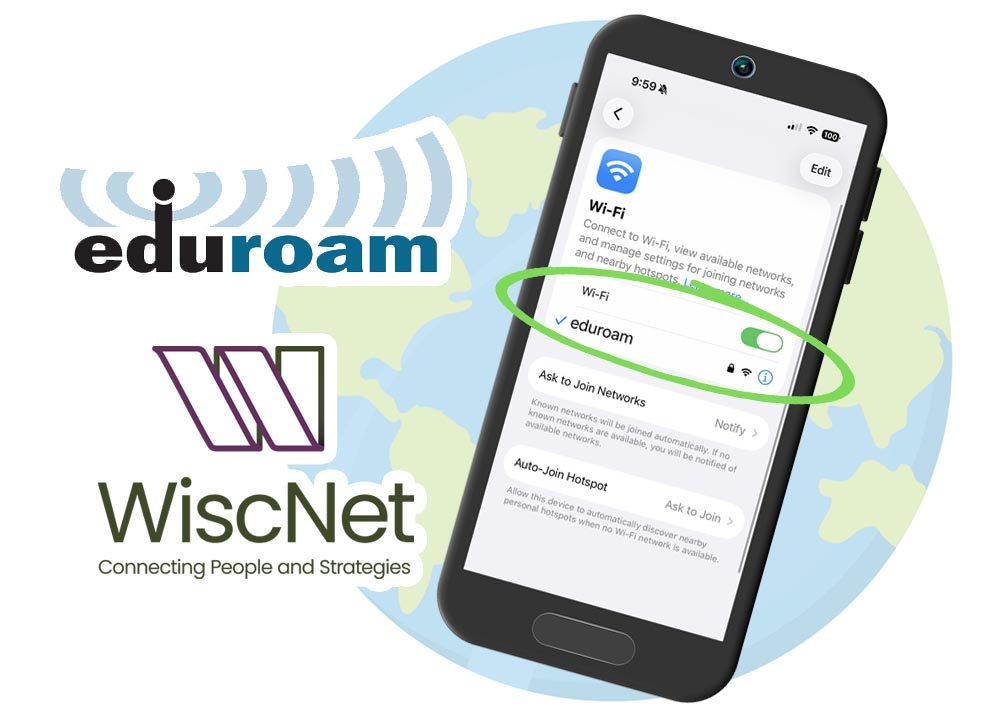
What they’re using is eduroam (education roaming), a simple, secure roaming access service developed for the research and education community. This uninterrupted Wi-Fi keeps users connected across educational sites and other locations in their region and worldwide wherever there are eduroam hotspots — and all that’s required after activation is opening up a computing device to automatically connect.
WiscNet is taking the lead on turning this roaming Wi-Fi service into a powerful statewide resource that keeps our research and education community connected across the state and around the world. This requires building out a robust network of eduroam sites in Wisconsin, and that’s where your organization comes in. Wisconsin already has a handful of eduroam hotspots in place, and WiscNet has completed two successful pilot programs. We envision Wisconsin becoming the next state to create an eduroam community. The stage is set: WiscNet is the support organization that’s ready to walk you through every step, the technical barrier to set up is low, and eduroam is included in WiscNet membership for the next three years.
Explore this page to learn more, or if you’re ready to get started with eduroam now, set up a discovery call today with WiscNet Chief Technology Officer Rich Turiel.
Get connected
Hotspots Near Me

eduroam connects people at almost 40,000 locations in more than 100 countries around the world.
-
eduroam provides many benefits to your school’s students, teachers, administrators and staff that were only previously available to the higher education and research community. Dual-enrolled students, staff working between multiple buildings and students/staff participating in interschool extracurricular activities don’t need to switch wireless networks to continue digital coursework. This also includes teachers and administrators who frequently travel between schools as well as students who regularly visit other schools at drop-offs, competitions and other after-school programs.
-
In this digital age, internet access is essential in and out of classrooms. Make your venue more attractive to students and staff by offering eduroam as a wireless guest network. There is no need for guest registration for eduroam visitors, and it requires minimal IT resources.
-
The goal with eduroam is to create a network of hotspot locations that makes internet access ubiquitous. By becoming an eduroam service provider, your organization is granting internet access to research and education community members, which does two things at the same time: It makes your place of business more attractive to those learners and educators, and it helps bridge the digital divide by making internet access more readily available in public and commercial spaces.
Three (of many) benefits of use
“A statewide eduroam presence would be highly beneficial. It would enable staff and students to consistently use a more secured wireless network rather than relying on open guest networks, thereby reducing security risks and improving the overall user experience.”
— David Digiovanni, director of IT infrastructure at Madison College (a WiscNet member)
-
eduroam’s privacy-preserving technology uses the most secure encryption and authentication standards in existence today. It is more secure than commercial hotspots, public WiFi, web browser forums or other open networks.
eduroam requires the use of 802.1x which provides end-to-end encryption to ensure that your private user credentials are only available to your home institution. The certificate of your home institution is the only point you need to trust regardless of who operates any intermediate infrastructure.Be aware though that when using the general Internet at an eduroam hotspot, the local site security measures at that hotspot will apply to you as well. For example, the firewall settings at the visited place may be different from those you are used to at home, and as a guest you may have access to fewer services on the Internet than you have at home.
-
Once a device is authenticated by your school or organization, there are no usernames or passwords. Staff and students will automatically connect wherever there is an eduroam hotspot. Once you’ve connected for the first time, you never need to enter your details again. You could be halfway across the world — or at a neighboring school or library in your town — and realize you are automatically connected to the internet via eduroam.
The user credentials are kept secure because eduroam does not share them with the site you’re visiting. Instead they are forwarded to the user’s home institution, where they can be verified and validated.The system uses a network of servers run by the institutions, and the participating National Research and Education Networks (NRENs) to securely route these requests back to your home institute. All this happens seamlessly and virtually instantly – all thanks to eduroam.
-
When it’s available in as many schools, libraries, museums, and public spaces as possible, it becomes a powerful service across the state and around the globe. The service has been around since 2003 and includes more than 10,000 hotspots in over 100 territories around the world. As Wisconsin’s map of eduroam sites grows, so does its value.
Set up a call today to become an eduroam service provider (which allows guests to connect to your secure eduroam network) or an identity provider (which allows your organization to authenticate your own eduroam users and respond to connection requests from eduroam access points worldwide).
The eduroam value
-
“Implementing eduroam was a fairly easy process and has aligned us with many of the higher-ed institutions in the state. Any chance we have to make tech simpler and easier to use for our end users, we should take advantage of that.”
–Steve Schlomann, CIO/CTO at the School District of Waukesha“Anytime we have outdoor events in the summer, students will connect to our outdoor eduroam network. We see usage during graduations when the campus is full of students and public.
“Every time we have a foreign exchange student or if we have other students from UW sites visiting us, they are all familiar with eduroam and know how it works.”
–Mihai Dumitrescu-Mihaly, senior network infrastructure engineer at Mid-State Technical College“Staff frequently report positive experiences when traveling and encountering eduroam networks at other institutions. In many cases, connectivity is automatic based on saved credentials and device settings — once a device is configured, it can automatically connect to eduroam networks worldwide without additional user intervention.” –David Digiovanni, director of IT infrastructure at Madison College
-
As Wisconsin’s eduroam Support Organization (eSO), WiscNet plays a singular role in expanding eduroam across the state. The value of eduroam grows with its ubiquity — when it’s available in as many schools, libraries, museums, and public spaces as possible, it becomes a powerful, statewide service that enables seamless connectivity for students, educators, and community members wherever they go.
As Wisconsin’s eSO, WiscNet’s responsibilities include:
Provisioning eduroam for new K12, library, and museum participants
Providing ongoing first-level support
Maintaining an inventory of participating sites
Collaborating with other eduroam support organizations to share feedback and ideas across the community
Through this work, WiscNet helps make eduroam a truly statewide resource — strengthening connectivity, mobility, and community learning throughout Wisconsin.
-
By using the eduroam service, you indicate that any information you provide is true, accurate, current, and complete. Further, you agree to use the eduroam service in a lawful manner and shall not:
Encourage any illegal, abusive or similar activities that interfere with the business of Merit Network or any other party.
Attempt to bypass or break any security mechanism or component of the eduroam service. • Use the eduroam service in a manner that poses a security or service risk to WiscNet or any of its users.
Test, decompile, or reverse-engineer the eduroam service or any equipment or services related to the eduroam service for any reason.
Use the eduroam service in a manner that subjects WiscNet or any third party to liability or damages.
Launch or facilitate, whether intentionally or unintentionally, a denial of service attack on the eduroam service or any component of the eduroam service, or engage in any other conduct that adversely impacts the availability, reliability, or stability of the eduroam service.
Transmit any material that contains viruses, trojan horses, worms, or any other malicious, harmful, or deleterious programs.
Use the eduroam service in a manner that violates any policy that WiscNet provided or made available to your organization.
Engage in any unsolicited advertising, marketing, or other similar activities.
Use the eduroam service to harvest or otherwise collect information about others, including email addresses or phone numbers.
Use the eduroam service to engage in or in connection with fraudulent activity.
Violate or facilitate the violation of any local, state, federal, or foreign law or regulation, including laws and regulations regarding the transmission of data or software.
Take any action to participate in, encourage, or promote any activity prohibited under this Acceptable Use Policy or any other agreement to which you are bound in connection with use of the eduroam service.
Transmit any material that infringes the intellectual property rights or other rights of third parties.
Remove, obscure, or alter any notice of copyright, trademark, or other proprietary right appearing in or on any component of the eduroam service. eduroam AUP (4/2018)
Transmit any material that is libelous, defamatory, discriminatory, or otherwise malicious or harmful to any person or entity.
Create a false identity or otherwise attempt to mislead others as to the identity of the sender or the origin of a message.
Use the eduroam service, or any component of the eduroam service, in any manner that violates any applicable international or domestic law.