This interactive storytelling tool is designed to help WiscNet members practice responding to cyber threats in realistic scenarios. Users choose a role on the cybersecurity incident response team. Through engaging, guided simulations set in the fictional community of Sudden Valley, Wisconsin, users face escalating challenges such as ransomware and phishing attacks. They make strategic decisions, roll dice to determine outcomes, and learn incident response best practices in a gamified experience.
This is a practical guide for handling real cybersecurity incidents without panic or finger-pointing. Built on **NIST Cybersecurity Framework (CSF) 2.0**, it walks organizations through what to do _before, during, and after_ an incident using the CSF functions: Govern, Identify, Protect, Detect, Respond, and Recover. Instead of vague policy fluff, it focuses on clear roles, decision points, communication paths, and repeatable actions.
What is Mr. Pixel's’ Opus?
March 6, 2026: Wisconsin Tech College System AI Summit - Madison, WI
March 8-10, 2026: Brainstorm 2026 - Wisconsin Dells, WI
March 12, 2026: WiscNet Board of Directors Meeting - Virtual (private)
April 1, 2026: The Quilt Artificial Intelligence Workgroup - Virtual (private)
April 13-16, 2026: Internet2 Community Exchange 2026 - Chicago, IL
WiscNet Connections 2026
Thursday April 30th, 2026
12:45 pm - 3:00 pm - SentryWorld
Stevens Point, Wisconsin
As advanced cyberinfrastructure investments accelerate across the United States—through initiatives such as NSF’s Advanced Cyberinfrastructure Coordination Ecosystem: Services & Support (ACCESS) program ($52M over five years) and the National Artificial Intelligence Research Resource (NAIRR) ($35M over five years)—a gap remains between those who build and operate advanced research infrastructure and those who want to use it for teaching and learning. This session explores a question: How might WiscNet serve as a connector between researchers with advanced cyberinfrastructure resources and educators seeking meaningful access to those resources for student learning?
On one side of the equation are researchers. Many principal investigators (PIs) and research computing teams operate sophisticated distributed computing environments, specialized datasets, AI/ML platforms, and domain-specific tools. In some cases, they even have excess compute capacity. Yet they often lack the time, networks, or support structures needed to identify educators who could meaningfully use these resources in the classroom. Even when interest exists, translating research infrastructure into educational use requires coordination, support, and trust—things that individual labs are not structured to provide at scale.
On the other side are educators—faculty, instructional designers, and academic leaders—who increasingly want their students learning with the tools, data, and environments that define modern research and industry practice. They want authenticity. They want relevance. They want their students working with advanced AI models, large datasets, high-performance computing, or emerging cyberinfrastructure platforms. But educators often struggle to find partners, navigate access pathways, or secure sustainable support for integrating research-grade infrastructure into curricula.
On Thursday, April 30th, from 12:45 pm - 3:00 pm, WiscNet will be hosting a special post-WiscNet Connections event to kick off something new and exciting.
This session reframes WiscNet’s role not simply as a network provider, but as a research and education networking platform—and potentially as a research and education cyberinfrastructure platform. The distinction matters. Networking, in this context, is both technical and relational. It involves connecting people, organizations, and systems in ways that lower friction and enable collaboration. Beyond networking, there is an opportunity to explore distributed computing models that intentionally serve both research and education communities.
Participants will explore a conceptual continuum: research as the discovery of new knowledge and education as the teaching and learning of existing knowledge. Too often, these are treated as separate domains with separate infrastructure, funding streams, and communities of practice. Yet the future of workforce development, AI literacy, and advanced digital skills demands tighter coupling between them.
The session will examine practical models for bridging this divide:
Mechanisms for matchmaking between researchers with excess capacity and educators with curricular needs
Governance and support frameworks to ensure responsible, secure, and sustainable shared use
Opportunities for researchers and educators to engage with each other
Distributed infrastructure approaches that enable community-scale access without compromising research performance
Policy and funding alignment with national cyberinfrastructure initiatives
We invite attendees to imagine WiscNet as a connector that sits between research and education—facilitating advanced networking, enabling distributed computing, and cultivating a community of practice where discovery and learning reinforce one another.
Ultimately, this session is about designing infrastructure not just for discovery and instruction, but for the ecosystem that connects them. If we can intentionally align advanced research cyberinfrastructure with educators' and students' needs, we can accelerate innovation, democratize access to cutting-edge tools, and better prepare learners for what’s next.
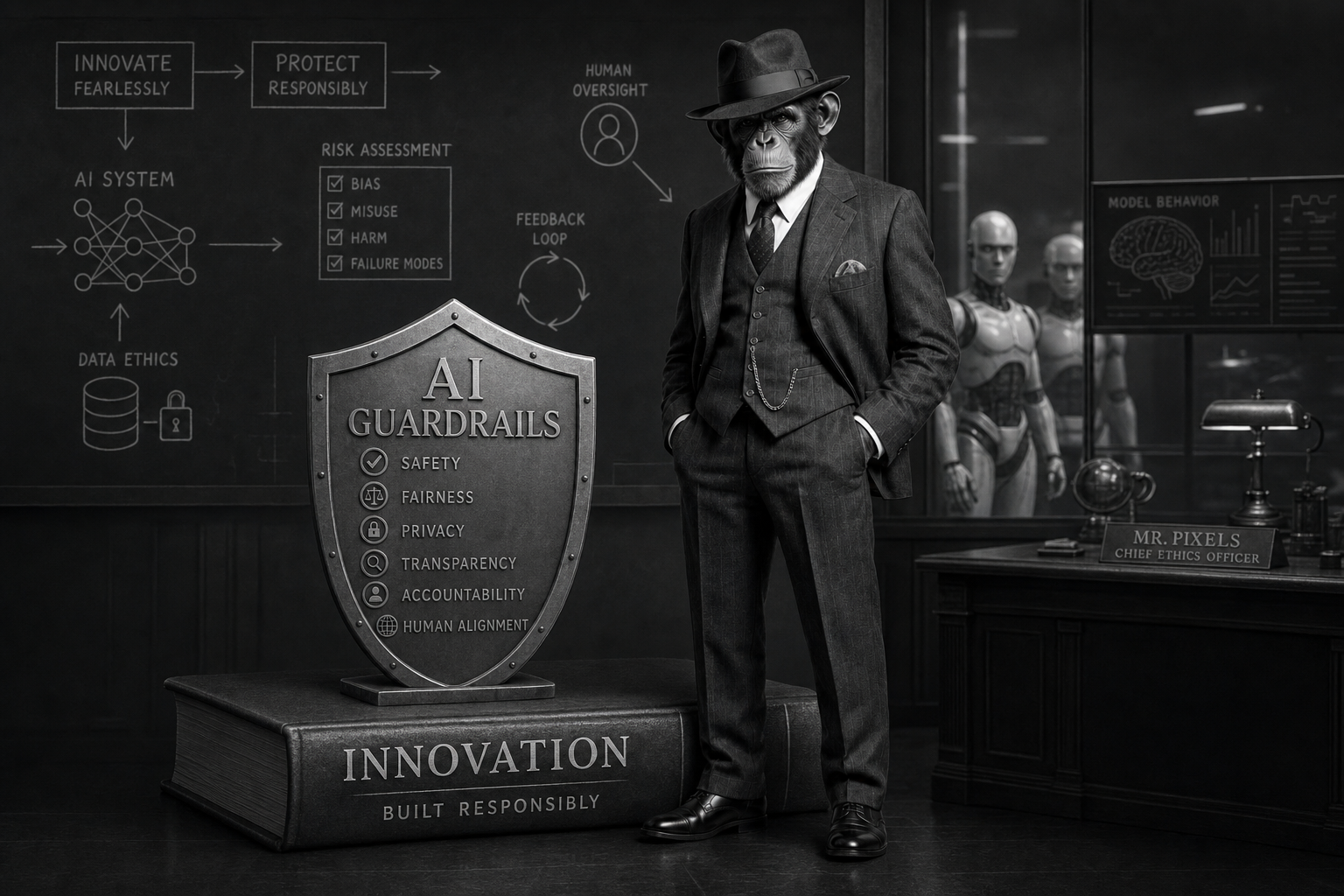
I know that’s a lot, so we’ll have Mr. Pixels break things down.
Listen. Innovation is about seeing connections that other people miss and actually doing something about them. AI isn’t some polite little train—it’s a stampede, and the smart folks are building fence posts, not hiding from the cows. That’s the energy we’re bringing to this session at WiscNet Connections.
Now here’s the part where you stop overthinking it.
Look. Click on the image of Mr. Pixels. Yes, my glorious, attic-dwelling face. Click it.
Then smash the big red button to register—the big red button. You cannot miss it. It’s red. It’s bold. It’s basically yelling your name.
You can join me all day Thursday for the full innovation deep dive, or go all in at WiscNet Connections on April 29 and 30.
Bottom line: when you register, use the coupon code mrpixels. Type it in. Feel powerful. Then I’ll see you there.
Everything is connected—even that big red button.
““If WiscNet is to networking what farm-to-table is to agriculture, John is an excellent fertilizer spreader.””