
1. Mobile Beacon - Inseego MiFi X Pro 5G (T-Mobile M3000B)
The Inseego MiFi X Pro 5G is a flagship mobile hotspot designed for users who need fast, reliable internet connectivity away from home or office. Sold under the M3000B model by T-Mobile, it was released in November 2022 and has since become one of the more capable portable hotspot devices on the market. It bridges the gap between consumer convenience and enterprise-grade networking, making it suitable for remote workers, travelers, fleet operations, and anyone who needs a dependable wireless connection on the go.
At the heart of the MiFi X Pro is the Qualcomm Snapdragon X62 modem-RF system, which provides 5G sub-6 GHz connectivity (mid-band and low-band) alongside 4G LTE fallback. The T-Mobile variant does not include mmWave (millimeter-wave) support — that distinction belongs to the Verizon M3100 model, which uses the X65 modem. On LTE, the device is rated Cat 22 with a theoretical maximum downlink speed of 2.5 Gbps, while the 5G side supports speeds up to 1 Gbps through features like SRS Antenna Switching and 5G carrier aggregation (NRCA). Inseego's proprietary antenna design and performance algorithms are tuned to maintain consistent signal even in marginal coverage areas.
The device supports Wi-Fi 6 (802.11ax) on both 2.4 GHz and 5 GHz bands simultaneously, allowing up to 32 Wi-Fi devices to connect at once. It also supports primary and guest network separation, so you can keep personal devices and shared access logically isolated. Beyond wireless, the MiFi X Pro includes a 1 Gbps Ethernet port for wired connections — a feature that's especially useful for stationary setups like RVs, boats, or temporary offices — as well as a USB-C port for tethering or charging other devices.
Security is a strong suit here. The device supports OpenVPN, VPN passthrough, static IP, Wi-Fi privacy separation, and WPA3 encryption. These enterprise-grade features make it appropriate for business users who need to access corporate networks securely from remote locations.
The battery is a 5,050 mAh Li-Ion unit with 18W Qualcomm Quick Charge 3.0 support. Inseego claims all-day battery life, though actual runtime depends heavily on the number of connected devices and activity level. A notable feature is the proprietary battery preservation mode, which allows 24/7 operation when connected to AC power — essentially turning the hotspot into a semi-permanent router without degrading the battery over time.
The 2.4-inch IPS color touchscreen provides at-a-glance information about signal strength, Wi-Fi credentials, connected devices, and data usage. Setup and management can also be handled through the Inseego Mobile app on iOS or Android, and for fleet or enterprise deployments, Inseego Connect offers centralized remote management across distributed devices.
The physical footprint is compact and pocketable. The device is designed and developed in the USA (manufactured in Taiwan) and carries certifications from T-Mobile for use on their network. It supports a wide array of LTE bands (1, 2, 3, 4, 5, 7, 8, 12, 13, 20, 25, 26, 28, 38, 39, 40, 41, 46, 48, 66, 71) and 5G NR bands (n1, n2, n3, n5, n7, n20, n25, n28, n40, n41, n48, n66, n71, n77, n78), giving it broad domestic and some international compatibility.
Key Specs at a Glance:
Modem: Qualcomm Snapdragon X62
Connectivity: 5G Sub-6 + 4G LTE Cat 22
Max Speed: Up to 1 Gbps (5G), 2.5 Gbps theoretical (LTE)
Wi-Fi: Wi-Fi 6 (2.4 GHz + 5 GHz), up to 32 devices
Ports: 1 Gbps Ethernet, USB-C
Battery: 5,050 mAh, Quick Charge 3.0
Display: 2.4" IPS color touchscreen
Security: WPA3, OpenVPN, VPN passthrough, Wi-Fi privacy separation
Management: Inseego Mobile App, Inseego Connect (enterprise)
OS Support: Windows 10+, macOS 10.10+, Linux Ubuntu 14.04+, Chrome OS v79+
NVIDIA DGX Spark
The NVIDIA DGX Spark is a desktop-class AI supercomputer that launched in October 2025, evolving from the "Project Digits" concept shown at CES earlier that year. It represents NVIDIA's push to bring data-center-grade AI capabilities down to a form factor small enough to sit on a desk — roughly the size of a Mac Mini at 150 × 150 × 50.5 mm. The target audience is AI developers, researchers, and data scientists who need to prototype, fine-tune, and run inference on large language models locally without relying on cloud infrastructure or expensive GPU clusters.
The device is built around the NVIDIA GB10 Grace Blackwell Superchip, a system-on-chip that integrates a 20-core ARM CPU (10 Cortex-X925 performance cores and 10 Cortex-A725 efficiency cores) with a Blackwell architecture GPU featuring 6,144 CUDA cores and fifth-generation Tensor Cores. The CPU and GPU share 128 GB of unified LPDDR5x memory through NVIDIA's NVLink-C2C technology, which provides 5x the bandwidth of PCIe Gen 5. This coherent memory architecture is the device's standout feature — it eliminates the overhead of system-to-VRAM data transfers that bottleneck traditional GPU setups and allows very large models to be loaded directly into a single addressable memory pool.
NVIDIA claims up to 1 petaFLOP of AI performance at FP4 precision (using the sparsity feature of the Tensor Cores). In practical terms, this means the DGX Spark can run inference on AI models with up to 200 billion parameters and fine-tune models up to 70 billion parameters. Two units can be linked together via dual QSFP Ethernet ports (200 Gb/s aggregate bandwidth) for distributed inference on models up to 405 billion parameters.
Storage comes in the form of a 4 TB NVMe SSD. The device runs Ubuntu Linux and ships with the full NVIDIA AI software stack preinstalled, including CUDA libraries, NVIDIA NIM microservices, and frameworks like Isaac (robotics), Metropolis (smart cities/computer vision), and Holoscan (real-time streaming analytics). NVIDIA's NemoClaw — part of the Agent Toolkit — is included for building, evaluating, and deploying autonomous AI agents locally.
The DGX Spark is powered through a USB-C connection drawing up to 240W from an external power supply. This external PSU design gives the chassis more thermal headroom, and NVIDIA's metal-foam cooling system keeps the unit stable under sustained loads without thermal throttling — a notable advantage over some competitors in similar form factors.
At $4,699, the DGX Spark is positioned as a bridge between consumer hardware (like RTX-equipped PCs) and full-scale data center infrastructure. Systems are available directly from NVIDIA's marketplace and through partners including Acer, ASUS, Dell, GIGABYTE, HP, Lenovo, MSI, and retailers like Micro Center.
Key Specs at a Glance:
SoC: NVIDIA GB10 Grace Blackwell Superchip
CPU: 20-core ARM (10× Cortex-X925 + 10× Cortex-A725)
GPU: Blackwell, 6,144 CUDA cores, 5th-gen Tensor Cores
Memory: 128 GB unified LPDDR5x (CPU+GPU coherent)
Storage: 4 TB NVMe SSD
AI Performance: Up to 1 PFLOP (FP4 sparse)
Networking: Dual QSFP Ethernet (200 Gb/s aggregate)
Inference Capacity: Up to 200B parameters (single), 405B (dual-linked)
Fine-tuning Capacity: Up to 70B parameters
Power: 240W USB-C (external PSU)
Dimensions: 150 × 150 × 50.5 mm
OS: Ubuntu Linux (preinstalled with NVIDIA AI stack)
Price: $4,699
3. Cisco ASR 920 Series Aggregation Services Router
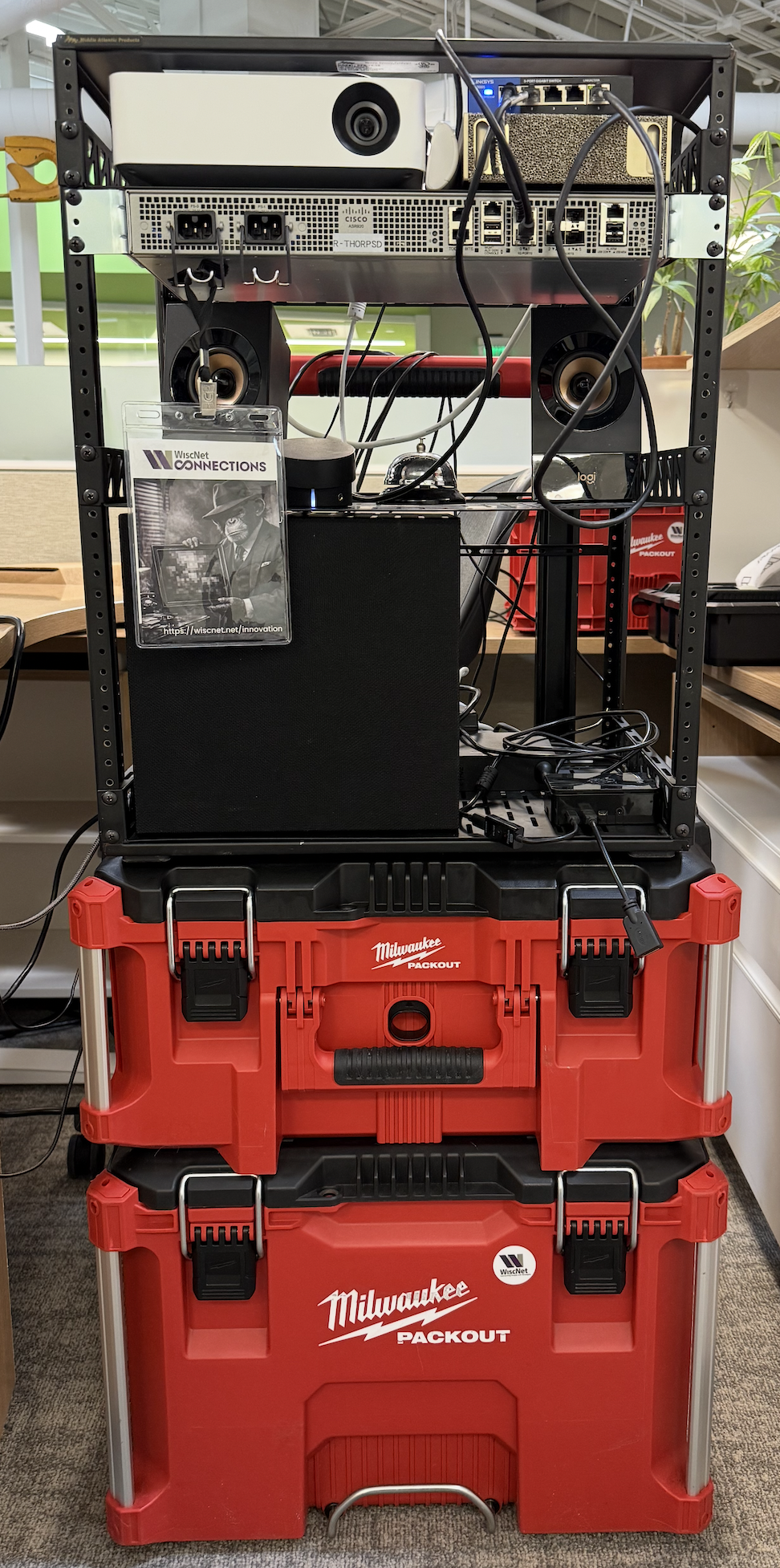
Note: This is a broken, decommissioned piece for effect. Not plugged into power.
The Cisco ASR 920 is a carrier-grade aggregation services router designed for service providers and large enterprises that need to deliver converged wireline and wireless services from the network edge. It sits in the access and pre-aggregation layers of service provider networks, handling tasks like mobile backhaul, business Ethernet services, IPTV delivery, and metro Ethernet aggregation. This is not a consumer router — it's a purpose-built platform for Carrier Ethernet environments running Cisco IOS XE.
The ASR 920 family comes in multiple hardware configurations, broadly split into low-port-density and high-port-density models. Low-density models like the ASR-920-12CZ (12 GE ports + 2 × 10GE uplinks) and ASR-920-4SZ (4 × 1/10GE SFP ports) are designed for small cell sites, remote cabinets, and edge locations where space and power are constrained. High-density models like the ASR-920-24SZ-M and ASR-920-24SZ-IM add more ports, interface module slots, and in some cases TDM interfaces (DS-0 through OC-12/STM-4) for legacy circuit emulation. All models fit into a 1RU form factor (the 24SZ-IM is 1.5RU with interface modules installed).
At the silicon level, the ASR 920 is powered by Cisco's custom Carrier Ethernet ASIC, which was specifically designed for service provider workloads. This ASIC delivers uninterrupted line-rate performance while handling complex services like hierarchical QoS (HQoS) with a three-level scheduling algorithm, access control lists (ACLs), and MPLS label switching simultaneously. The platform supports up to 40 Gbps of forwarding capacity depending on the model.
The feature set is deep. On the Layer 2 side, the ASR 920 supports VPLS (Virtual Private LAN Services), H-VPLS, Ethernet OAM (802.1ag, Y.1731), and EFP (Ethernet Flow Point) service instances. On Layer 3, it handles full IP routing, MPLS, L2VPN, and L3VPN services, effectively allowing service providers to push MPLS-based VPN services all the way into the access layer. Segment Routing (SR) support is available on newer software releases. For mobile backhaul, the device provides Synchronous Ethernet (SyncE) and IEEE 1588v2 PTP timing, with Class B timing compliance models meeting ITU G.8273.2 specifications for 5G networks. Some models include a pluggable GNSS module and dedicated 1PPS/10MHz/ToD timing interfaces.
The ASR 920 is temperature-hardened for extended operating ranges (typically -40°C to 65°C), and passively cooled models are available for deployment in sealed outdoor cabinets where fan noise and dust ingress are concerns. Power options include AC and DC supplies, and redundancy is built into the chassis. A "dying gasp" feature alerts the network management system when power is lost at the device.
Management and provisioning are handled through Cisco IOS XE — a modular operating system designed for feature velocity and resiliency — and through Cisco Prime Infrastructure for end-to-end network management across EPN (Evolved Programmable Network) architectures. An optional pay-as-you-grow licensing model lets operators activate features incrementally as revenue justifies it.
Key Specs at a Glance:
Platform: Carrier Ethernet access/aggregation router
ASIC: Cisco custom Carrier Ethernet ASIC
Forwarding Capacity: Up to 40 Gbps
Form Factor: 1RU (some models 1.5RU)
Ports: GE copper/fiber, 10GE SFP+, optional TDM (model-dependent)
Protocols: MPLS, VPLS, L2VPN, L3VPN, Segment Routing, IP/MPLS
Timing: SyncE, IEEE 1588v2 PTP, Class B compliant models available
QoS: Three-level HQoS with large queue scale
Operating Temp: -40°C to 65°C (extended), passively cooled options
Power: AC or DC, redundant, built-in
Software: Cisco IOS XE
Management: Cisco Prime, CLI, NETCONF/YANG
4. Linksys SE3005 5-Port Gigabit Ethernet Switch
The Linksys SE3005 is about as straightforward as networking hardware gets. It's an unmanaged 5-port Gigabit Ethernet switch designed for home offices, small workgroups, or any situation where you need to expand the number of wired Ethernet ports available on your network. There's no configuration, no management interface, and no software to install — you plug it in, connect your devices, and it works.
The switch provides five 10/100/1000 Mbps auto-sensing Ethernet ports, meaning each port automatically negotiates the fastest speed the connected device supports. All five ports support auto MDI/MDI-X detection, so you don't need to worry about whether you're using a straight-through or crossover cable — the switch figures it out. This is a store-and-forward switch, which means it receives an entire frame before forwarding it, checking for errors in the process and only passing along valid data.
The SE3005 operates at wire speed with non-blocking architecture, so all five ports can run at full Gigabit simultaneously without bottlenecking each other. For a five-port switch, this means a maximum throughput of 10 Gbps (full duplex across all ports). QoS (Quality of Service) prioritization is handled automatically based on IEEE 802.1p frame priority tags, which can help ensure that time-sensitive traffic like VoIP or video streaming gets preferential treatment without any manual configuration.
Power consumption is minimal. The SE3005 features Linksys' Green Ethernet technology, which detects link status and cable length and adjusts power consumption accordingly. When a port has no active link, it reduces power to that port. When a shorter cable is detected, it scales power down since less energy is needed to push a signal over a shorter distance. The device draws roughly 3.5W under typical operation and uses an external power adapter.
Physically, the SE3005 is a compact plastic enclosure measuring approximately 3.9 × 3.9 × 1.1 inches and weighing under half a pound. It can sit flat on a desk or be wall-mounted. There are no fans — cooling is entirely passive, so the switch operates silently. LED indicators on the front panel show link status and activity for each port.
This is a Layer 2 device only. There's no routing capability, no VLAN support, no port mirroring, no SNMP management, and no web interface. If you need any of those features, you'd step up to a managed switch. The SE3005's entire value proposition is simplicity and reliability — it creates a small Ethernet segment, forwards traffic between connected devices at line rate, and does so without any ongoing attention.
The SE3005 supports IEEE 802.3 (10BASE-T), 802.3u (100BASE-TX), 802.3ab (1000BASE-T), and 802.3x (flow control). It comes with a limited lifetime warranty from Linksys and is widely available at retail for around $25-30.
Common use cases include expanding the ports on a home router that only has four Ethernet jacks, creating a small wired network segment for a home office or gaming setup, or connecting devices like NAS boxes, printers, desktops, and game consoles that benefit from wired rather than wireless connectivity.
Key Specs at a Glance:
Ports: 5 × 10/100/1000 Mbps RJ-45
Switching Capacity: 10 Gbps (full duplex)
Type: Unmanaged, store-and-forward
Auto-sensing: Speed and MDI/MDI-X on all ports
QoS: IEEE 802.1p automatic prioritization
Power: External adapter, ~3.5W typical, Green Ethernet
Dimensions: ~3.9 × 3.9 × 1.1 in
Weight: ~0.4 lbs
Cooling: Fanless, passive
Standards: 802.3, 802.3u, 802.3ab, 802.3x
Warranty: Limited lifetime
5. Raspberry Pi 4 Model B
The Raspberry Pi 4 Model B is the fourth-generation flagship single-board computer from Raspberry Pi Holdings, released on June 24, 2019. It marked a substantial leap in capability over its predecessor, the Pi 3 Model B+, bringing genuine desktop-class performance to a credit-card-sized board while maintaining the sub-$100 price point and low power consumption that made the Raspberry Pi line famous. Raspberry Pi has committed to keeping the Pi 4 in production until at least January 2034, making it a long-term-supported platform for embedded and hobbyist applications.
The processor is a Broadcom BCM2711 SoC featuring a quad-core ARM Cortex-A72 (ARMv8-A) CPU clocked at 1.5 GHz (later revisions using the C0 stepping run at 1.8 GHz with improved thermals). This represents roughly a 50% performance increase over the BCM2837 in the Pi 3 series. Each core has 32 KB of L1 data cache and 48 KB of L1 instruction cache, with a shared 1 MB L2 cache. The GPU is a VideoCore VI clocked at 500 MHz, supporting OpenGL ES 3.0, hardware H.265 decode at 4Kp60, and H.264 decode at 1080p60 (with 1080p30 encode).
RAM options include 1 GB, 2 GB, 4 GB, and 8 GB of LPDDR4-3200 SDRAM. The 4 GB variant is the most popular general-purpose option, while the 8 GB model suits heavier workloads like running multiple services simultaneously or working with larger datasets. The base 1 GB model (now discontinued in many regions) maintained the traditional $35 price point; higher-RAM models cost more.
Connectivity was dramatically upgraded. The Pi 4 was the first model to include USB 3.0 ports (two USB 3.0 plus two USB 2.0), providing significantly faster data transfer for external storage and peripherals. Networking includes true Gigabit Ethernet (no longer bottlenecked by a shared USB bus as in previous models) and dual-band 802.11ac Wi-Fi (2.4 GHz and 5 GHz) with Bluetooth 5.0/BLE. The Ethernet port also supports Power over Ethernet with an optional PoE HAT add-on.
Video output moved from a single full-size HDMI port to two micro-HDMI ports, enabling dual-display setups at up to 4K resolution (two 4K displays at 30 fps, or one at 60 fps). A 4-pole 3.5mm jack provides composite video and stereo audio output. There are also dedicated camera (CSI) and display (DSI) ribbon cable connectors, and the standard 40-pin GPIO header maintains full backward compatibility with previous Pi models and the vast ecosystem of HATs and add-on boards.
The Pi 4 boots from a microSD card by default, but it also supports USB boot, meaning you can run the OS from a USB SSD for significantly better storage performance. Power is supplied via USB-C at 5V/3A (15W). The recommended ambient operating temperature is 0 to 50°C, and the board is designed for sprint-style performance — clocking up when needed and scaling back during idle periods for thermal management.
The operating system ecosystem is centered on Raspberry Pi OS (formerly Raspbian), a Debian-based Linux distribution, though Ubuntu, LibreELEC, RetroPie, and dozens of other distributions are also available. The Pi 4's capabilities make it viable as a lightweight desktop computer, media center, retro gaming console, home automation hub, NAS controller, network monitoring appliance, or prototyping platform for IoT and embedded applications.
Key Specs at a Glance:
SoC: Broadcom BCM2711, quad-core Cortex-A72 @ 1.5 GHz (1.8 GHz on C0 rev)
GPU: VideoCore VI @ 500 MHz, OpenGL ES 3.0
RAM: 1 / 2 / 4 / 8 GB LPDDR4-3200
Storage: microSD, USB boot supported
USB: 2 × USB 3.0, 2 × USB 2.0
Networking: Gigabit Ethernet, dual-band 802.11ac Wi-Fi, Bluetooth 5.0
Video Out: 2 × micro-HDMI (up to 4Kp60)
Audio: 3.5mm stereo + composite video, HDMI audio
GPIO: 40-pin header (backward-compatible)
Power: 5V/3A via USB-C (15W)
Dimensions: 85.6 × 56.5 mm
Price: $35 (1GB) to $75 (8GB)
Production Support: Through at least January 2034
6. LG ProBeam Laser Projector (BU Series)
The LG ProBeam line is a family of professional-grade 4K laser projectors designed for business, education, digital signage, and large-venue presentation environments. The series includes several models — the BU50NST, BU50RG, BU53RG, BU60RG, and BU70QGA — each varying in brightness, throw ratio, and feature set, but all sharing a common foundation of 4K UHD resolution and laser light source technology. The BU53RG and BU50RG are among the most commonly referenced models in the lineup.
All ProBeam models project at 4K UHD resolution (3840 × 2160), delivering 8.3 million discrete pixels. On the BU50NST, this is achieved through XPR (Expanded Pixel Resolution) processing on a DLP chipset, while newer models in the BU-RG series use similar high-resolution processing pipelines. Brightness ranges from 5,000 ANSI lumens on the BU50/BU53 models up to 6,000 lumens on the BU60RG and 7,000 lumens on the BU70QGA. These brightness levels are designed to produce clear, readable images even in rooms with significant ambient lighting — a common requirement in conference rooms, classrooms, and lecture halls.
The laser light source is a defining feature. Unlike traditional lamp-based projectors that degrade in brightness over time and require periodic bulb replacements, the ProBeam's laser source is rated for up to 20,000 hours of use. LG suggests that at 8 hours per day, this translates to roughly 7 years of operation before meaningful brightness degradation. This dramatically reduces maintenance costs and downtime compared to lamp projectors, and the laser source also eliminates mercury, making it more environmentally friendly.
Screen size capability is impressive — the ProBeam can project images from 40 inches up to 300 inches depending on throw distance. Some models, like the BU53RG, feature a shorter throw ratio (projecting a 40-inch image from just 0.79 meters), while others, like the BU50RG, offer a 1.6x zoom lens for more flexible placement. All models include lens shift (typically H ±20%, V ±50%) and multi-point warping (up to 4, 9, 15, or 25 points depending on the model), allowing precise alignment on uneven surfaces or off-center installations. Image rotation and flipping are also supported.
Connectivity includes dual HDMI inputs, USB Type-A ports for media playback, an RS-232C serial port for integration with control systems, and on some models, an RJ-45 HDBaseT port for long-distance HDMI signal transmission over standard Ethernet cable. Built-in Wi-Fi enables wireless mirroring from compatible smart devices, and a built-in web browser provides direct content access. Dual 5W speakers handle basic audio needs, with an analog audio output for routing to external systems.
The ProBeam runs LG's webOS signage platform, which provides a built-in software ecosystem for digital signage applications. LG SuperSign CMS enables remote content creation, scheduling, and distribution across multiple projectors, while LG ConnectedCare offers cloud-based remote monitoring and fault diagnosis. For medical environments, the projectors support DICOM 14-compliant grayscale imaging, making them suitable for medical conference and educational use.
Power consumption runs around 380W during operation with a standby draw under 0.5W. The form factor is compact for a business projector — the BU53RG is notably marketed as the smallest 4K 5,000-lumen projector available at 16.7 liters.
Key Specs at a Glance (BU53RG representative):
Resolution: 4K UHD (3840 × 2160), 8.3 megapixels
Brightness: 5,000 ANSI lumens (up to 7,000 on BU70QGA)
Light Source: Laser, rated 20,000 hours
Screen Size: 40" to 300"
Throw Ratio: Short throw (BU53RG), standard throw (BU50RG)
Lens Shift: H ±20%, V ±50%
Zoom: 1.2x (BU53RG) to 1.6x (BU50RG)
Warping: Up to 25-point image correction
Inputs: 2 × HDMI, 2 × USB-A, RJ-45 (HDBaseT), RS-232C
Audio: 2 × 5W speakers, analog audio out
Software: webOS signage platform, SuperSign CMS, ConnectedCare
Power: ~380W operating, <0.5W standby
HDR: HDR10 support (select models)
7. Logitech Z533 2.1 Speaker System with Subwoofer
The Logitech Z533 is a 2.1-channel multimedia speaker system aimed at users who want a meaningful step up from built-in laptop speakers or cheap desktop audio without jumping to the complexity and cost of audiophile-grade equipment. It slots into a sweet spot for desk-bound PC users, console gamers, and home media consumers who want room-filling sound with solid bass response at a reasonable price point (typically around $70-90 at retail).
The system consists of two satellite speakers and a front-facing subwoofer. Total system power is rated at 60W RMS (120W peak). The subwoofer houses the amplifier and handles low-frequency output through a fabric-lined, down-firing driver enclosed in a dedicated cabinet measuring 10.43" × 10.03" × 7.67" and weighing approximately 8.82 lbs. The satellite speakers use 2.25-inch (5.7 cm) full-range drivers in compact enclosures measuring 6.69" × 3.93" × 3.34" at about 1.16 lbs each. The system's frequency response spans 55 Hz to 20 kHz, covering the usable range from low bass through high treble.
The defining user-facing feature is the wired control pod. This small puck-shaped controller connects to the subwoofer and provides power on/off, a rotary dial for volume adjustment, a separate bass level control, a 3.5mm headphone jack, and an additional 3.5mm auxiliary input. The pod is designed to sit on your desk within arm's reach, giving you physical controls without needing to reach behind furniture or navigate software mixers.
Connectivity is handled through a combination of one 3.5mm stereo jack and two sets of RCA inputs on the back of the subwoofer, plus the additional 3.5mm input on the control pod. This means you can have up to three audio sources connected simultaneously — for instance, your PC via 3.5mm, a TV via RCA, and a phone via the control pod — and switch between them without unplugging anything. The system is entirely wired; there is no Bluetooth or Wi-Fi capability.
The Z533 is a universal audio system in terms of compatibility. It works with PCs, Macs, PlayStation, Xbox, Nintendo consoles, TVs, tablets, smartphones, DVD/Blu-ray players, and digital audio players — essentially anything with a 3.5mm headphone jack or RCA audio output. A 3.5mm audio cable is included in the box along with the two satellites, subwoofer, and control pod.
Logitech has manufactured the Z533 for several years at this point, and it remains in active production. Build quality is functional but not premium — the enclosures are plastic with a matte black finish and copper-accented driver cones on the satellites. The design is straightforward and doesn't call attention to itself on a desk.
The primary limitation is the lack of wireless connectivity — if you want Bluetooth, Logitech's Z407 fills a similar niche. There's also no optical/digital input, no USB audio, and no app-based EQ control. What you get is a simple, reliable, wired 2.1 system that sounds significantly better than its price would suggest, with enough bass presence to make movies and games feel immersive and enough clarity for music listening at reasonable volumes.
Key Specs at a Glance:
Configuration: 2.1 (2 satellites + 1 subwoofer)
Power: 60W RMS / 120W peak
Frequency Response: 55 Hz – 20 kHz
Satellite Drivers: 2.25" (5.7 cm) full-range
Inputs: 1 × 3.5mm, 2 × RCA, 1 × 3.5mm (control pod)
Output: 3.5mm headphone jack (control pod)
Subwoofer Dimensions: 10.43" × 10.03" × 7.67"
Satellite Dimensions: 6.69" × 3.93" × 3.34"
Subwoofer Weight: ~8.82 lbs
Satellite Weight: ~1.16 lbs each
Wireless: None (wired only)
Included: 2 satellites, subwoofer, control pod, 3.5mm cable
Warranty: 1 year limited
8. Milwaukee Packout Modular Storage System
The Milwaukee Packout is a modular tool storage and organization system that has become something of an industry standard among professional tradespeople, DIYers, and anyone who needs to transport and organize a significant amount of gear. Introduced by Milwaukee Tool (a subsidiary of Techtronic Industries), Packout's core value proposition is its interlocking design — every piece in the system physically clicks together and locks into place, creating a stackable, portable, customizable storage rig that can be configured to match virtually any workflow.
The locking mechanism is the foundation of the entire system. Each Packout component features a proprietary IP65-rated connection system on its top and/or bottom that allows units to snap together securely. When locked, the stack can be tilted, carried, or rolled without the components separating. This is a meaningful upgrade over traditional toolboxes that simply sit on top of each other and slide apart in transit.
The ecosystem is extensive. The core lineup includes tool boxes in multiple sizes (standard, compact, deep), rolling tool chests, drawer units (2-drawer and 3-drawer configurations), organizers with removable bins, crates, tote bags, backpacks, coolers, first aid kits, radio/charger combos, and mounting plates for wall or vehicle installation. Milwaukee continues to expand the line regularly, and the interlocking interface remains consistent across all products, so early adopters can integrate new components with existing setups.
The Rolling Tool Chest is often the base of a Packout stack. It features a reinforced metal frame, industrial-grade casters with a locking mechanism, a telescoping metal handle, and a large lower storage compartment. You stack toolboxes, organizers, and other components on top, lock them together, and roll the whole assembly as a single unit. For vehicle-based work, Packout mounting plates bolt to truck beds, van floors, or workshop walls, providing a fixed base that Packout components lock onto so they don't shift during transport.
Materials across the line emphasize impact resistance and durability. The cases use a reinforced polymer construction that Milwaukee rates for impact resistance in job site conditions. Metal-reinforced corners, heavy-duty latches, and IP65-rated weather sealing (on most components) protect contents from dust, debris, and water exposure. The organizers feature thick-walled removable bins that are individually removable and reconfigurable.
The Packout system isn't limited to tool storage in the traditional sense. The modular design has been adopted by a wide range of users outside the trades — photographers use it for camera gear, outdoor enthusiasts configure it for camping supplies, boaters use it for marine equipment and tackle, and overlanders build Packout stacks for vehicle-based adventure rigs. The weather sealing and impact resistance make it suitable for environments where standard plastic bins or soft bags would be inadequate.
Pricing varies by component. Individual toolboxes typically run $40-80, organizers $30-50, the rolling chest $130-180, and specialty items like the cooler or radio/charger vary further. Building a full Packout stack can add up quickly, but the durability and modularity tend to justify the cost for users who rely on it daily.
Key Specs at a Glance:
System Type: Modular interlocking tool/gear storage
Locking Mechanism: Proprietary IP65-rated interlock
Material: Impact-resistant reinforced polymer, metal-reinforced corners
Weather Rating: IP65 (dust-tight, water jet resistant) on most components
Core Components: Toolboxes, organizers, drawers, rolling chest, crates, tote, backpack
Mounting Options: Wall plates, vehicle/truck bed plates
Rolling Base: Reinforced metal frame, industrial casters, telescoping handle
Ecosystem: 50+ compatible products and growing
Manufacturer: Milwaukee Tool (Techtronic Industries)
Typical Price Range: $30–$180+ per component
9. Jerky Boys Beef Jerky
Jerky Boys is a small-batch, premium beef jerky brand that has built a following based on a family recipe passed down through multiple generations. The company positions itself firmly in the artisan/craft jerky space, emphasizing hand-cut preparation, high-quality prime beef, and a deliberate avoidance of mass-production shortcuts. It's not gas station jerky — the brand targets consumers willing to pay a premium for a noticeably better product.
The flagship product is the Classic Beef Jerky, which comes in 3.25 oz bags. The flavor profile leans on a traditional marinade base that includes Worcestershire sauce, soy sauce, onion powder, garlic powder, and liquid smoke. The result is a savory, slightly smoky jerky with enough seasoning to keep things interesting without relying on excessive heat or sugar. The texture skews toward tender rather than the hard, chewy, teeth-challenging consistency that plagues many commercial jerkies — this is one of the brand's most frequently cited selling points in customer reviews.
Nutritionally, the product is positioned as a high-protein, low-carb snack. The company advertises approximately 27 grams of protein per bag. The ingredient list is kept relatively clean, with an emphasis on no preservatives. This aligns with the broader consumer shift toward whole-food, minimally processed snack options, and makes it a reasonable option for keto, paleo, and low-carb dieters who rely on jerky as a portable protein source.
The Jerky Boys operation is based out of Arizona and is family-owned and operated. The company also offers bison and elk jerky options, extending the lineup beyond traditional beef for customers who want leaner or more exotic protein sources. Distribution appears to be primarily direct-to-consumer through the company's website (jerkyboys.com), with some Amazon presence as well. A 2-pack of the Classic Beef Jerky runs $29.99, and the company offers a subscription option at a slight discount ($26.99) for recurring monthly delivery.
The brand has recently expanded its visibility through a motorsports sponsorship, serving as the primary sponsor for Caden Kvapil and the No. 88 Chevrolet Late Model for JR Motorsports. This type of sponsorship aligns with the jerky market's traditional overlap with motorsports, outdoor sports, and the general "active lifestyle" demographic.
It's worth noting that "Jerky Boys" as a brand name also has a separate association with the famous prank call comedy duo from the 1990s, who sell their own branded jerky through jerkyboysstore.com. The two are distinct brands — the Arizona-based Jerky Boys Beef Jerky company at jerkyboys.com is the craft jerky producer described here.
Customer reviews consistently praise the flavor and tenderness. Repeat purchase rates appear strong based on review sentiment, with many customers noting they've ordered multiple times. The common refrain is that the quality justifies the premium price, and that it compares favorably to — or exceeds — other well-known craft jerky brands.
Key Specs at a Glance:
Product: Premium hand-cut beef jerky
Flagship Flavor: Classic Beef Jerky
Package Size: 3.25 oz per bag
Protein: ~27g per bag
Ingredients: Beef, Worcestershire sauce, soy sauce, onion powder, garlic powder, liquid smoke
Preservatives: None claimed
Other Varieties: Bison, elk
Pricing: $29.99 (2-pack), $26.99 (subscription)
Availability: jerkyboys.com, Amazon
Origin: Family-owned, Arizona, USA
10. Monster Energy Zero Ultra ("The White Monster")
Monster Energy Zero Ultra — colloquially known as "The White Monster" for its distinctive white can with silver claw logo — is Monster Beverage Corporation's flagship zero-sugar energy drink. It was one of the early entries in the zero-calorie energy drink category and has since become one of the best-selling SKUs in the entire Monster lineup, appealing to consumers who want the energy boost without the sugar load.
The flavor profile is described as a light, sparkling citrus taste that's deliberately less sweet than the original green Monster. It's designed to be refreshing rather than syrupy — think of it as a lightly flavored sparkling beverage with an energy blend backbone, rather than the heavy, cough-syrup-adjacent experience of some traditional energy drinks. The "zero sugar" branding is technically accurate — the drink contains 0 grams of sugar and only 10 calories per can (in the standard 16 fl oz size), sweetened instead with a combination of erythritol (a sugar alcohol), sucralose, and acesulfame potassium.
The energy blend is the standard Monster formulation adapted for a sugar-free delivery: caffeine (approximately 140-150 mg per 16 oz can), taurine, Panax ginseng extract/flavor, L-carnitine L-tartrate, glucuronolactone, and inositol. The B-vitamin complex includes niacinamide (B3), D-calcium pantothenate (B5), pyridoxine hydrochloride (B6), and cyanocobalamin (B12). These are fairly standard energy drink ingredients, and the caffeine content is roughly equivalent to a large cup of coffee.
The full ingredient list includes carbonated water, citric acid, erythritol, taurine, sodium citrate, natural and artificial flavors, Panax ginseng flavor/extract, L-carnitine L-tartrate, caffeine, sucralose, sorbic acid (preservative), benzoic acid (preservative), the B-vitamin complex, acesulfame potassium, inositol, and in some formulations, salt, guarana extract, and D-glucuronolactone. The formulation varies slightly between can sizes and regional markets.
Monster Zero Ultra is available in multiple package sizes: the standard 16 fl oz can (most common), a 24 fl oz resealable can, and multi-pack configurations (4-pack, 6-pack, 15-pack). Retail pricing varies but typically runs $2-3 per individual 16 oz can, with multi-packs offering better per-unit economics.
The White Monster is part of a broader Ultra sub-line that includes flavor variants like Ultra Rosa (pink, guava-strawberry), Ultra Violet (purple, grape), Ultra Red (berry), Ultra Blue (citrus-berry), Ultra Peachy Keen, Ultra Watermelon, Ultra Vice Guava, and Ultra Gold (pineapple), among others. All Ultra variants share the zero-sugar formulation. The White Monster remains the original and most popular of the bunch.
From a dietary standpoint, the drink is essentially calorie-free for practical purposes, contains no sugar, and delivers a moderate caffeine dose. It's not a health drink — it contains artificial sweeteners and preservatives — but it represents a significantly lighter option than the original Monster Energy, which packs 54 grams of sugar and 210 calories per can. The drink is not recommended for children, pregnant or nursing women, or individuals sensitive to caffeine.
Key Specs at a Glance:
Calories: 10 per 16 oz can
Sugar: 0g
Caffeine: ~140-150 mg per 16 oz can
Sweeteners: Erythritol, sucralose, acesulfame potassium
Key Blend Ingredients: Taurine, Panax ginseng, L-carnitine, inositol, B-vitamins (B3, B5, B6, B12)
Preservatives: Sorbic acid, benzoic acid
Available Sizes: 16 fl oz (standard), 24 fl oz
Flavor: Light citrus, sparkling
Multi-packs: 4, 6, 15-pack options
Sub-line: Monster Ultra (10+ flavor variants)
Carbonated: Yes
11. Mr. Pixel's Tears Hot Sauce
Note: This product does not appear to have a verifiable web presence as of March 2026. Searches for "Mr. Pixel's Tears" hot sauce across major retail platforms (Amazon, specialty hot sauce retailers, Kickstarter, social media) return no matching results. There are several similarly-named products and brands in the hot sauce space — Pixel Peppers (a retro-gaming-themed craft hot sauce brand), Happy Tears Hot Sauce Company (a small-batch smoked sauce brand), and Totec's Tears by Harmacy Hot Sauce Co. (a pasilla and plum sauce) — but none that match the exact name "Mr. Pixel's Tears."
It's possible this is a very small-batch, local, or newly launched product that hasn't yet built an online retail footprint, or the name may be slightly different from what was provided. Hot sauce is an extraordinarily fragmented market with thousands of micro-brands, many of which sell only at farmers markets, local shops, or through personal social media channels before (if ever) scaling to broader distribution.
If this is a product you've seen in person or been recommended, a few details would help me track it down: where you encountered it (a store, a market, a specific website), any details about the label design, the pepper varieties or heat level, or even the approximate region it's from. Gaming and pixel-art-themed food products have been a growing niche — Pixel Peppers on Kickstarter is one example — so it's plausible that "Mr. Pixel's Tears" fits into that retro-gaming craft food aesthetic.
Without verifiable product information, I can't responsibly provide specs, ingredient lists, Scoville ratings, or nutritional data. Fabricating details would do you a disservice. If you can share any additional context, I'm happy to dig deeper, or if this is a product concept you're developing for your Great Loop app list, I can help brainstorm the branding and positioning instead.
What I Can Confirm Does NOT Match:
Pixel Peppers: A Kickstarter-funded retro-gaming hot sauce brand — different name and brand identity.
Happy Tears Hot Sauce Company: A small-batch smoked sauce brand — no "Pixel" or "Mr." in the name.
Totec's Tears (Harmacy Hot Sauce Co.): A pasilla and plum sauce — entirely different brand.
Mr. Pain (Pepper Palace): A habanero extract sauce — different product and brand.
12. Classic Service Bell
An Icon of Hospitality
Sitting against a clean white background, this image presents a quintessential service bell — the kind that has graced hotel front desks, restaurant host stands, and shop counters for well over a century. It's a deceptively simple object, but one loaded with cultural meaning, mechanical elegance, and a surprising amount of design thought packed into a form no bigger than a clenched fist.
Physical Form and Construction
The bell is composed of two primary sections that contrast sharply in both color and material. The upper dome is a highly polished chrome or nickel-plated metal, curved into a smooth, symmetrical hemisphere. Its surface is so reflective that it acts almost like a convex mirror, capturing distorted reflections of the surrounding environment — you can see the dark smudges of ambient shadow curving across its face, along with bright highlights where the studio lighting strikes it most directly. The reflections give the dome a liquid, almost mercurial quality, as though the metal were not quite solid but hovering somewhere between a solid object and a pool of silver.
At the very apex of the dome sits the striker button — a small, flat-topped plunger made of the same polished metal. It's mounted on a short post with a visible spring mechanism, a tiny coiled spring that allows the button to depress and snap back. This is the functional heart of the bell: pressing the button drives a small hammer against the interior wall of the dome, producing that unmistakable, bright, clear ding — a single clean note that cuts through ambient noise without being harsh or aggressive.
The lower section is the base, made from what appears to be a glossy black-painted or lacquered metal, possibly cast iron or steel. It's shaped like a wide, shallow dish or saucer with a gentle concave curve that flares outward at the bottom, giving the bell a stable, weighted footprint. The base serves a dual purpose: it anchors the bell firmly to whatever surface it sits on (preventing it from sliding when struck), and it provides visual grounding — a dark, heavy platform that makes the bright dome appear to float above it.
Between the dome and the base, a narrow band of exposed brushed or satin-finished metal is visible, a slim ring where the dome meets the base housing. This ring creates a clean visual separation between the two halves and hints at the internal mechanics — the cavity where the clapper mechanism lives.
Design and Aesthetics
What makes this particular bell visually appealing is the interplay of three finishes: the mirror-bright chrome dome, the glossy black enamel base, and the subtle matte ring at the junction. These three textures and tones create a layered, almost architectural composition. The proportions are pleasing — the dome is slightly wider than it is tall, giving it a squat, confident stance rather than a pinched or elongated look. The base extends just far enough beyond the dome's edge to frame it without overwhelming it.
The overall silhouette is one of those universally recognized shapes, like a lightbulb or a padlock. Even rendered as a tiny icon or a silhouette, most people would immediately identify it. That kind of instant legibility is a hallmark of great industrial design — form so well-matched to function that the object becomes its own symbol.
Cultural Weight
The service bell carries a particular emotional resonance. It represents the moment of requesting attention — a polite, mechanical announcement that says "I'm here, and I need something." It's assertive without being rude, which is why it endures in hospitality settings. There's a slight thrill in pressing one, a small act of agency. Hotels, in particular, have made the bell a part of their brand iconography, symbolizing attentive service and the promise that someone is always ready to help.
It also carries a faintly nostalgic quality. In an era of digital kiosks and automated check-ins, the analog bell feels like a relic of a more personal, human-scaled approach to service — a time when transactions began with a ding and a smile rather than a touchscreen prompt.
Final Observation
This image, stripped of context and background, isolates the bell as a pure object — almost sculptural. It invites you to appreciate the craftsmanship and design clarity of something most people tap without a second thought. It's a small, everyday masterpiece hiding in plain sight.